




URGENCH STATE MEDICAL INSTITUTE CONDUCTS ONLINE SURVEYS WITH 4,741 PARTICIPANTS
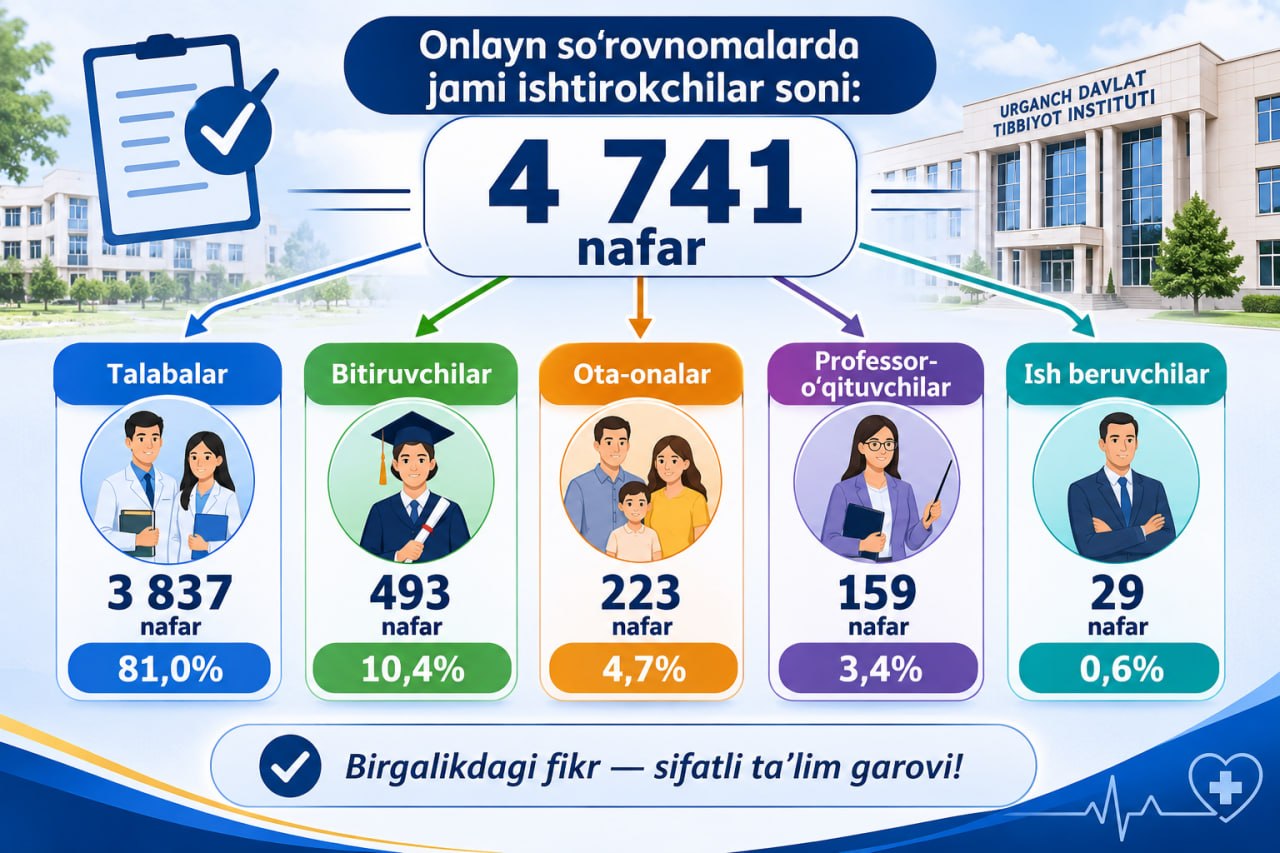
To further enhance the quality of education, identify existing opportunities and challenges within the educational process, and examine the social environment at the institution, Urgench State Medical Institute conducted online surveys among students, parents, faculty members, graduates, and employers. These surveys were organized in accordance with the 2025/2026 academic year work plan of the institute’s Education Quality Control Department. The questionnaires were made available on the institute’s official website, facilitating the collection of public opinion on various aspects of the educational process. A total of 4,741 individuals participated, including 3,837 students, 493 graduates, 223 parents, 159 faculty members, and 29 employers.
Student Feedback: A Key Criterion for Improving Educational Quality
The student survey, which consisted of 15 questions, explored students’ perspectives on the educational process, the performance of the faculty, opportunities for independent study, and the overall environment provided by the institute.
Regarding the objectivity of how faculty members assess student knowledge, 37% of respondents stated that all instructors grade fairly, while 35% indicated that this is true for the majority of instructors. At the same time, some respondents pointed out specific shortcomings in the assessment process.
The conditions provided for independent study received a positive assessment from the majority of students. At the same time, suggestions were made to provide additional spaces for independent study within the libraries. Among the proposals put forward by students to further enhance the quality of education, priority was given to the implementation of modern teaching methods and digital technologies, an increase in the number of practical sessions, the expansion of laboratory and simulation-based training, and improved access to educational literature.
The perspectives of graduates and parents serve as an important indicator of educational outcomes.
A total of 493 graduates participated in the survey. In their responses, they emphasized the importance of professional expertise and the qualifications of the teaching staff, the effective use of information technology, and the availability of high-quality educational materials in organizing a modern educational process.
The views of graduates regarding collaboration with employers are particularly noteworthy. In their opinion, such engagement strengthens students’ professional training, fosters the development of practical knowledge and skills, and helps produce competitive specialists who meet the demands of the labor market. The survey of parents included 223 respondents. They stressed that a future physician must not only be a competent professional but also possess strong interpersonal skills for interacting with patients, as well as a deep sense of responsibility and dedication to their profession. Furthermore, parental feedback concerning student living conditions, the performance of the teaching staff, and the overall quality of education provided valuable insight into their perception of the institute’s operations.
The perspective of the teaching staff is a key factor in the development of the educational process.
The survey of faculty members involved 159 respondents. The results indicate that 70% of those surveyed regularly incorporate multimedia tools and online platforms into their teaching, 25% use them occasionally, and 5% reported that they do not utilize such tools. When evaluating the conditions in place to ensure high-quality education for students, 65% of the faculty indicated that all necessary requirements are met.
At the same time, some respondents pointed to the need for further improvements, specifically regarding classroom facilities, the provision of information and communication technology (ICT) resources, subject-specific educational equipment, anatomical models, and medical instruments. The survey results also touched upon issues such as the distribution of teaching workloads, the alignment of educational content with modern standards, and the engagement of students in various activities during their coursework.
Employer feedback serves as a key criterion for assessing the training of qualified medical professionals.
Twenty-nine employers participated in the survey. According to the results, 35% of employers rated the professional training of the institute’s graduates as «excellent,» 55% as «good,» and 10% as «average.» At the same time, some respondents pointed to the need for further improvements in classroom facilities, including the provision of information and communication technology (ICT) resources, subject-specific educational equipment, medical models, and clinical instruments. The survey results also addressed issues such as the distribution of the academic workload, the alignment of educational content with modern requirements, and the involvement of students in various activities during their studies.
Employer Assessment as a Criterion for the Training of Qualified Medical Personnel
Twenty-nine employers participated in the survey. According to the results, 35% of employers rated the professional training of the institute’s graduates as «excellent,» 55% as «good,» and 10% as «average.» Furthermore, a need was identified for the further development of graduates’ professional skills—specifically in areas such as establishing clinical diagnoses, conducting differential diagnoses, performing practical medical procedures, maintaining medical documentation, and the rational use of medications.
Suggestions also touched upon graduates’ patient communication and teamwork skills. Notably, 73% of respondents expressed satisfaction with the graduates’ interpersonal communication skills, while 27% reported dissatisfaction. Regarding practical skills, 65% of the feedback was positive, while 35% was negative. Employers emphasized the importance of increasing the number of practical sessions at clinical training sites, organizing masterclasses and hands-on seminars led by specialists, and fostering the development of students’ clinical reasoning.
Survey results serve as a foundation for defining specific objectives and future development plans. The results of online surveys have helped identify a number of priority tasks aimed at further improving the quality of education at the institute. Specifically, the following areas of focus have been established:
— creating additional conditions for independent student learning within libraries and information-resource centers;
— expanding the effective use of modern pedagogical technologies, digital educational platforms, and multimedia tools in the teaching and learning process;
— increasing the proportion of clinical, laboratory, and simulation-based sessions;
— enriching the collection of academic literature and electronic educational resources;
— strengthening cooperation with healthcare institutions and employers;
— developing students’ professional, practical, and communication competencies.
Furthermore, a key objective identified is to increase the participation of students and parents in surveys, while also enhancing outreach and awareness-raising efforts among them.
At the Urgench State Medical Institute, significant importance is placed on the opinions and suggestions of students, parents, faculty, graduates, and employers in the process of ensuring educational quality. After all, improving the quality of education is not merely the task of an educational institution; it is a shared goal and responsibility of society as a whole.
Conducting such surveys—aimed at refining the educational process—serves as a vital instrument within the institute’s internal quality assurance system, facilitating the resolution of identified issues and the continuous development of educational quality.
Urgench State Medical Institute
Department of Education Quality Control
